 Note: This is one in an occasional series of interviews with Colorado journalists.
By Ed Otte
Joe McGowan’s meeting with Fidel Castro in Havana was the result of being in the right place at the right time. And having a valid passport.
The Associated Press won a drawing Christmas week 1962 to have a reporter on a freighter delivering ransom supplies to Cuba. The AP bureau chief in Miami was told to pick a reporter who had been in Cuba before. The reporter selected had allowed his passport to expire. McGowan, who speaks Spanish, was then chosen to be the lone journalist to sail to Havana.
The former AP Denver bureau chief describes his encounter with Castro and his daylong excursion with the former Cuban dictator in “From Fidel Castro to Mother Teresa.” The visit occurred two months after the failed Bay of Pigs invasion and, following the U.S. blockade, one month after the Soviets removed their missiles from the island nation to end the Cuban Missile Crisis.
McGowan’s book, published in 2012, recounts his other AP bureau assignments in India and Peru, and reporting experiences on the Indian subcontinent, Caribbean and South America. His last bureau chief assignment began in 1978 in Denver. He retired from The AP on Dec. 31, 1997.
McGowan made a return trip to Cuba in January 1963 but Castro was unavailable to see him. In 2002, McGowan went to Cuba with the World Affairs Council of Philadelphia and spent two weeks touring the nation. He and his wife Babette Andre went to Cuba in 2012, again with the World Affairs Council.
Question: What is your reaction to President Obama’s announcement that the United States will normalize relations with Cuba?
McGowan: On the surface, this appears to be a very positive and long-overdue move. But I’ll wait to see exactly what Obama changes and if the stupid State Department in Washington completely lifts the embargo. There are news conjectures that Obama is going to use this to give Guantanamo Bay back to Cuba. In 2002, I broke away from the tour group and met with a University of Havana professor who had been a Cuban diplomat to the U.N. I asked him if Fidel had always been a communist. He replied Fidel had been a socialist but with imposition of the embargo during the Cold War, he turned to Moscow and became a communist.
What impressed you most about the economic and living conditions during your 2012 visit?
McGowan: Raul Castro had loosened some of the strict conditions that had existed under Fidel. For instance, Fidel had allowed paladares (literally palates) or small family restaurants to operate but only with family members. Raul loosened it to permit a family to hire employees not members of the family. We visited some large paladares operating like regular restaurants. It provided more jobs for Cubans. Because Cuban doctors were giving up their practice to go work as taxi drivers or waiters at the fancy seaside resorts built by Canadians, Spanish and others, Raul had to make a “special exception” and allow doctors to make more money in medical practice.
How had the country changed since your 2002 visit?
McGowan: It had deteriorated tremendously. Houses and office buildings desperately needed paint and upkeep. We were told that on average three buildings were collapsing each week in greater Havana. Food had to be gotten through ration stores. Our tour group visited one ration shop. That day it was out of rice and sugar, so even with that ration card you could not get any.
How will the new U.S.-Cuba relations affect average Cubans?
McGowan: Again, this will depend on exactly what Obama and the State Department allow in relations. Presumably a lot of American tourists will visit. Cubans will see Americans in nice clothing, with money to spend. If intermingling is allowed by Washington, Cubans will visit with Americans and learn about our prosperity, personal freedoms and property ownership.
After five decades of state-sponsored anti-U.S. propaganda, how will Cubans view America? Will they have greater access to U.S. news outlets?
McGowan: Because of the ill-advised and extremely harmful (my opinion) embargo imposed by Congress and Eisenhower, there are three generations of Cubans who have grown up being told they have hardships, including food shortages, because of the American bloqueo (blockade), which Cuba called the embargo. Will Raul’s government allow more access to U.S. news outlets? Eventually, people will obtain portable radios that can pick up signals from Florida and American travelers may be able to bring in U.S. newspapers, magazines and the Internet.
Many Americans’ perception of Cuba involves vintage U.S. cars, cigars, and baseball. How will that view change with greater access to Cuba?
McGowan: Again, it depends on if the State Department completely lifts the embargo. Under present rules, Americans traveling with a tour group registered with the State Department are not allowed to do anything that might be construed as fun or enjoyment. Tours must be engaged in educational and/or cultural endeavors and visit museums, libraries and medical clinics. In 2012, our tour stopped at Playa Giron (Bay of Pigs). My wife waded into the warm surf. If the State Department learned of this, the tour company might have lost its rights to take people to Cuba. Will American visitors be able to go to the seaside resorts? Under present State Department rules, U.S. tour groups are not allowed anywhere near the resorts. Visitors will be able to enjoy the lively Cuban music.
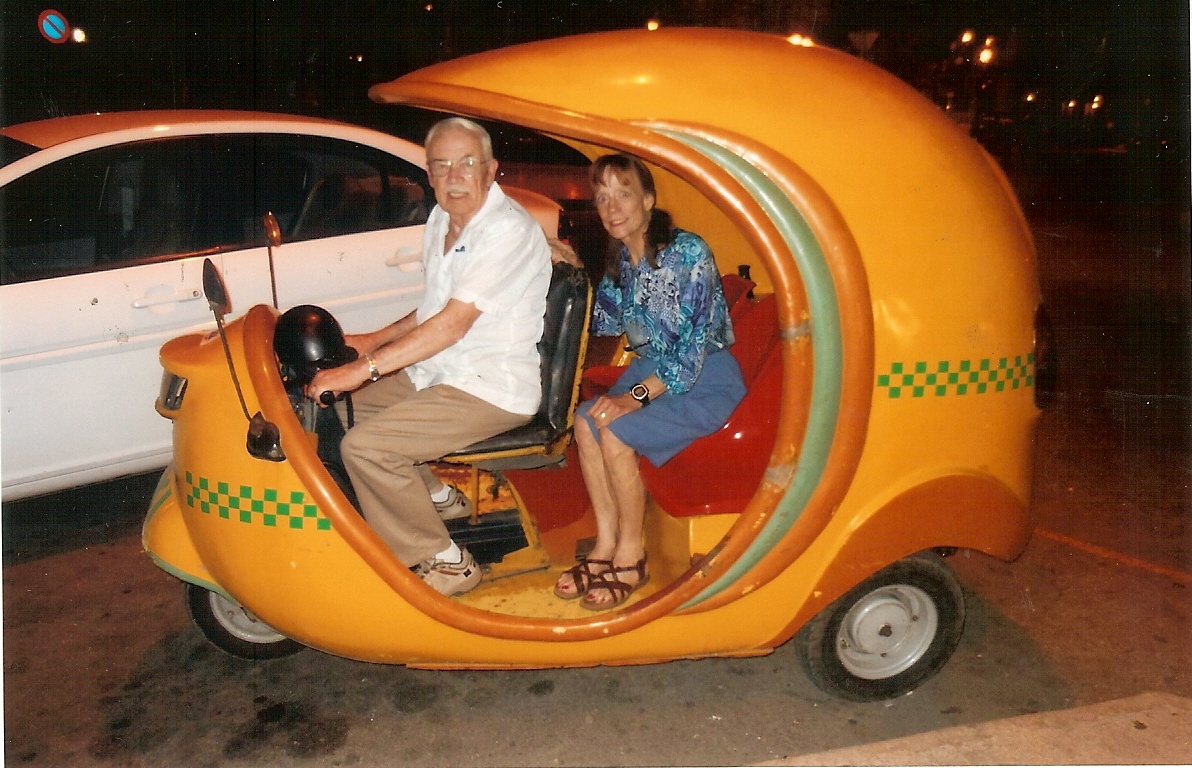
Joe McGowan and his wife Babette Andre in a coconut-shaped Coco taxi in Havana in 2012.
In your book. you write that Fidel Castro was a friend of Ernest Hemingway. Why did he like the American writer?
McGowan: I think Fidel admired Hemingway’s spirit of adventure, including his Spanish and African travels. They had been deep sea fishing partners. At Hemingway’s house in December, 1962, Castro lifted the mattress and showed the sheets of plywood that provided support for Hemingway’s back, injured in two plane crashes in Africa. At one point Castro pulled up a stool and looked out a window at the sea. After quite awhile, he turned and said: “I don’t think he wanted to die in bed.” That was a reference to Hemingway’s suicide the year before.
If you were a reporter today and assigned to an AP bureau in Havana, what stories would you want to write?
McGowan: Whether after Raul, less of the Cuban budget will go to the military (it gets about 70 percent) and more to the average Cuban. Are Cubans still lining up at the Cuban Interests Section (former U.S. Embassy) for visas to leave Cuba? Who comes after Raul? Two of the top contenders in 2012 when I visited were Ricardo Alarcon, veteran diplomat and moderate regarding the U.S.; or Carlos Lage, No. 1 in the Cuban communist party after Raul.
Discover more from Society of Professional Journalists | Colorado Chapter
Subscribe to get the latest posts sent to your email.
 Society of Professional Journalists | Colorado Chapter
You must be logged in to post a comment.