Note: This is one in an occasional series of interviews with Colorado journalists.
By Ed Otte
It takes grit, hard work, creativity and luck to survive 140 years. That – and three other key factors – explains the durability of the Silverton Standard & the Miner.
The 900-circulation nonprofit weekly, founded in 1875, is the oldest continuously published newspaper in Western Colorado.
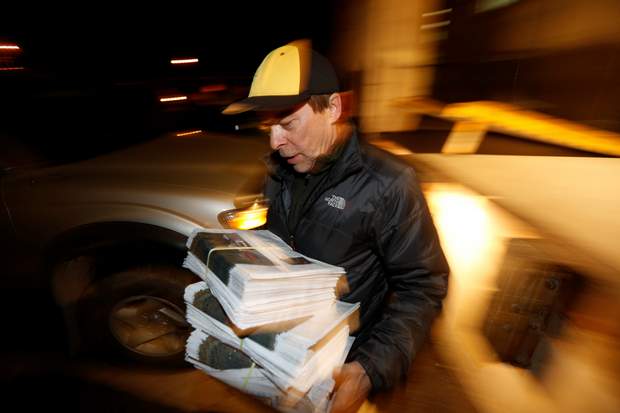
Courtesy of Jerry McBride/Durango Herald
Mark Esper reports, writes and edits the Silverton Standard & the Miner. He also delivers the paper, which he used to pick up every Thursday before sunrise from the dock at The Durango Herald building. The paper is now printed in Montrose.
One of the other key factors is that the Standard is a true reflection of its community. Nestled in a 9,305-feet elevation valley in the San Juan Mountains in Southwest Colorado, Silverton has survived mining busts, a declining population, geographic seclusion and brutal winters.
Geography and weather still define daily life. Today, the Durango & Silverton Narrow Gauge Railroad is a seasonal economic lifeline for the town of less than 600 year-round residents.
During all of these economic and weather cycles, the Standard reported the boom times and the misfortunes. That recorded history is one of the newspaper’s strongest characteristics. A weekly example is “Silverton Standard & Caboose,” a back-page compilation of old stories and photos from the town’s colorful past. The popular feature is an entertaining sidebar to the newspaper’s thorough coverage of current local news.
The second factor is editor and publisher Mark Esper. The third is the San Juan County Historical Society.

Courtesy of Shaun Stanley/Durango Herald
Mark Esper works the phone for a story for his Silverton Standard and The Miner newspaper from within his office in the old Hospital Building in Silverton.
In 2009, the Standard was on the brink of closure because the owner couldn’t find a buyer. Desperate to save the newspaper, Esper persuaded the historical society to acquire the publication. The unusual business transaction cast Esper – the self-described publisher, editor, reporter, photographer, advertising manager, classified manager, circulation manager and janitor – in an even more visible role in the community.
The new publishing arrangement was seen from the community’s perspective in a documentary by former Rocky Mountain News videographer Sonya Doctorian. Now the senior photo editor of The Washington Post Magazine, Doctorian shot “Publish or Perish: Silverton Saves Its Newspaper” in 2009.
The video can be seen on YouTube here https://www.youtube.com/watch?v=2gxAqLMU8UA&feature=related and on the newspaper’s website at www.silvertonstandard.com.
In November 2011, the Society of Professional Journalists designated the Standard as a National Historic Site in Journalism. The plaque dedication ceremony was conducted in early May 2012 at the historical society museum to coincide with the arrival of the first D&SNGRR train of the summer.
The SPJ Colorado Pro Chapter in 1969 honored the newspaper as a State Historic Site in Journalism.
Question: It has been five years since the San Juan County Historical Society assumed ownership of the Standard & the Miner. How would you describe the arrangement?
Esper: I would describe it as barely noticeable for the most part. I operate the newspaper and give a copy of our monthly financial statement to the historical society board president, Bev Rich.
Part of my agreement is that I have editorial freedom, and that has not been breached. And I treat the historical society the same as I would any other nonprofit organization.
We’ve managed to hold our own financially since May 2009 when the historical society acquired the newspaper as a donation.
Remember this was occurring in early 2009. Newspapers across the country were in freefall and the owner of the Telluride Daily Planet wanted out of Silverton. The financial statement for the previous year looked grim. This newspaper, which is the oldest business of any kind on the Western Slope of Colorado, was in grave peril. But somehow we ended that first year with a profit of $236 and I have never had to ask for a dime from the historical society since.
Question: Has the relationship caused any problems with news coverage or editorials?
Esper: Nothing serious. Currently there is a recall election going on against a town board member (long story, and trust me you probably do not want to know about it). The historical society board members are themselves split on that matter. However I haven’t gotten pressure from anyone on the board. The historical society is involved in so many projects I have to remind myself to put in a disclaimer line about ownership of the newspaper (though that is also made clear each week in our masthead). I am mindful of not trying to be seen as just some historical society newsletter. And we sure do not come close to that. I do not feel any real pressure from the historical society. I feel much more accountable to our readers, to be honest about it. I write some strong editorials from time to time and as far as I’m concerned that’s my job.
Question: The Durango Herald in November ran a story about you, with the headline “Silverton’s heroic Clark Kent,” about your coverage of a “scandal” involving a fired town employee, recall efforts of a town trustee and election letters to the editor. How difficult is it to cover controversial issues in a small town?
Esper: I came here from the Traverse City Record-Eagle in Michigan, a daily with a circulation of 29,000. I knew Silverton, (population 578) was going to be a different animal. Within a couple of months of arriving I had to cover a bar brawl in which four local people were arrested. And I knew all four of them. It’s just sheer luck I wasn’t at the Miners Tavern at the time. I was on my way down there when I saw all the flashing lights.
The intimacy has great advantages too, of course. I can take a photo including just about any five or six people in town and not have to jot down names and where they are in the photo. I know them all.
Then there was the time just six weeks ago when, after delivering the papers to the nine news vending boxes in town, I got back to the office and immediately received a call from the grocery store. Some kid had just stolen all the papers from the box. And she gave me the name. The kid’s mom was in the paper that week for a drug arrest. He hit every box in town and burned most of the papers before our undersheriff caught up with him. I didn’t press charges.
Question: How many community fundraisers do you conduct each year for the newspaper? What are the events and how much money do you raise?
We have two main fundraisers over the course of the year.
On Labor Day Weekend I produce the Silverton Western Movie Festival, where we feature old movies made in Silverton and the San Juans. These are mostly old Westerns from the 1950s. It’s pretty popular and brought in about $1,300 this year.
And we produce a calendar each year featuring historic photos of Silverton (along with some old funny stories from the Standard each month). That brings in $1,500 or $2,000 a year.
We also have a few generous benefactors who each write us a nice check each year. But the income from donations and fundraisers is less than 10 percent of our total income.
We are still a newspaper business first and foremost. Advertising and circulation is how we make money.
Question: Could this business model work for other nonprofit news organizations?
Esper: I think it could. However the Standard doesn’t really look like or operate much like a nonprofit, with fundraisers and outright donations comprising a small percent of our income. And our subscription rates and advertising rates are competitive with market prices. Community support is one advantage. I call it Silverton Public Newspaper.
Question: What happens to your readership and advertising when the summer train season ends and some Silverton businesses close for the winter?
The Durango & Silverton Narrow Gauge Railroad drops hundreds of pedestrians into downtown Silverton every day all summer long. It’s a big driver of the town’s summer economy. The train runs from May to the end of October. After that the town does get a bit dead, though we are seeing more winter tourism recently.
I typically cut my press run by 100 after the last train pulls out (unless it’s an even year and then I wait until after the election to drop my press run). Those 100 papers pretty much account for the seasonal fluctuation in rack sales.
We have many subscribers who summer here and winter elsewhere. So we typically will get a lot of address changes in May and October too. And our biggest growth is in our e-mail PDF edition.
But we have many subscribers who don’t ever get to Silverton. People who just love trains, people who love Western history.
As for advertising, we produce summer and winter editions of a glossy Destination: Silverton travel magazine that’s a very popular vehicle for our tourist-related businesses. There is a seasonal drop off in advertising too, of course. Simply fewer businesses open and fewer special events.
Question: You now drive the three-hour round-trip over 11,000-feet elevation Red Mountain Pass to pick up each week’s edition at the Montrose Daily Press. You had problems before due to snowstorms closing the two passes between Silverton and Durango. Will there be new challenges with Red Mountain Pass?
Esper: The drive to Durango early every Thursday morning was sometimes sketchy enough. I had to go over two mountain passes prone to avalanches. I would usually leave at around 5 a.m. The problem with that being that in the winter the avalanche experts don’t do their assessment of how bad it is until about 7:30 a.m. when it’s light enough to see. Twice I got caught on the Durango side after they closed the highway. I was the only one crazy enough to be driving through those avalanche paths in those conditions. I don’t look forward to the Red Mountain Pass trips.
Question: Do you still hear comments from people who see Doctorian’s documentary about the newspaper?
Esper: Not often. Though in 2012 I got a call out of the blue from a producer for the NBC “Today Show.” He had just seen it online somewhere and called up to ask if we were still around. He was going to pitch it as a story. And as it happens we were just about to get our National Historic Site in Journalism marker from the Society of Professional Journalists. So Bob Dotson came out to Silverton and did an “American Story” piece on the Standard for the “Today Show.”
Discover more from Society of Professional Journalists | Colorado Chapter
Subscribe to get the latest posts sent to your email.
 Society of Professional Journalists | Colorado Chapter
You must be logged in to post a comment.