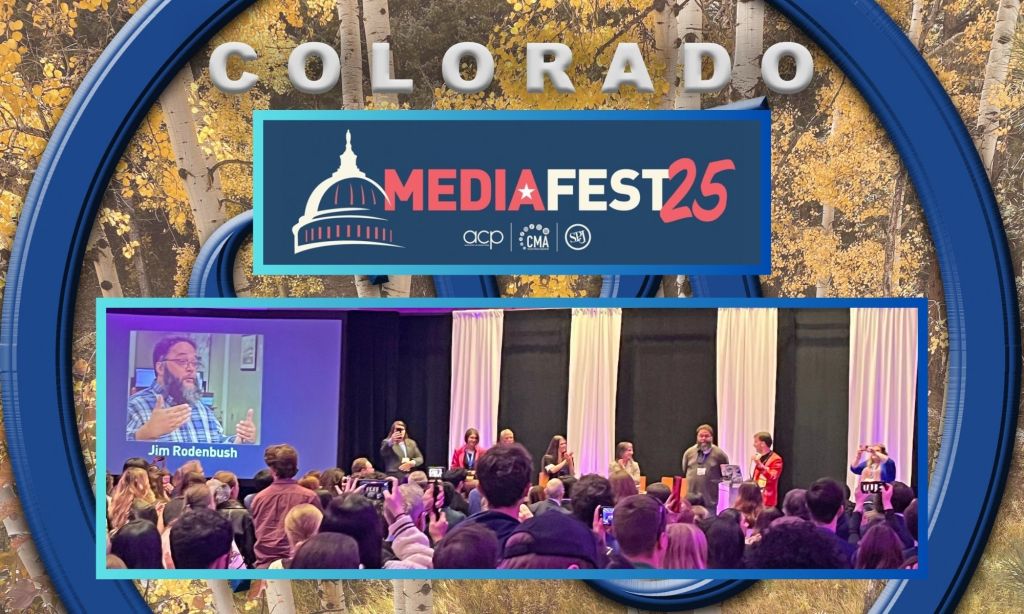
MediaFest25, the nation’s largest news-media gathering for professionals and college students, has concluded its four-day run in Washington, D.C.. The conference was sponsored by the Society of Professional Journalists, the Associated Collegiate Press and the College Media Association.
Michael Karlik, a member of the SPJ Colorado Pro chapter’s board of directors, was on hand for MediaFest. Here is his third dispatch from the conference. See links at the end for his first and second reports.
On Friday, October 17, the MediaFest keynote event started with a standing ovation for Jim Rodenbush, the former director of student media at Indiana University.
Earlier in the week, the school’s administration ordered the student paper to print no news, and only a homecoming guide, in its upcoming issue. Rodenbush refused to dictate what the paper could print. The university then fired him.
The conference organizers flew Rodenbush to Washington, D.C., to highlight the censorship issue.
As for the keynote itself, SPJ President Emily Bloch spoke with three journalists about the perils of the current moment for journalists.
Dean Baquet, the former executive editor of The New York Times and the Los Angeles Times, said it was good that there is experimentation happening with local journalism. His generation did not have much humility because they had a monopoly on the news, but journalists today are more aware of the need to build and connect with audiences, he said.
Instead, Baquet said he was worried about large news organizations like CBS capitulating to the government in the face of meritless legal threats. That makes it easier for smaller outlets to be sued who don’t have the resources to defend themselves, he said.
Baquet said transparency is a virtue. That could include putting pictures of journalists on our websites to show that we’re real people, he added.
Kat Tenbarge, cofounder of Spitfire News, said there is declining trust in news outlets but growing trust in individuals. Sometimes, that trust is misplaced because some social media journalists may not have training or ethical principles (though others do), she said, and at other times, journalists can be singled out for harassment or threats. However, she added, journalists need to be on those platforms to reach a younger audience.
Valeria Fernández, founder and director of Altavoz Lab, a Latino-led incubator for community journalists, said a lot of independent news outlets are collaborating. “Advocacy” and “calling things what they are” are two separate things, she said, adding that historically, there’s been a fear of calling things what they are.
Elsewhere on Friday, attendees from SPJ Region 9 (Colorado, Wyoming, Utah, and New Mexico) met briefly. Only Colorado and Utah were represented. McKenzie Romero, the regional coordinator, said she was impressed by the SPJ Colorado Pro Chapter‘s efforts to rebuild its membership. (Find out how to join SPJ and become an SPJ Colorado Pro chapter member for free.)
Longtime employees from Voice of America also spoke in a panel discussion about the government’s efforts to compromise VOA’s mission of providing factual, trusted news to 360 million global viewers.
Steven Herman said that when VOA stopped broadcasting, audience members wondered if there had been a coup in the United States. VOA was playing a crucial role in confirming what viewers saw to be happening in their own countries, contradicting propaganda from state network, he said, adding that cutting back on publicly funded, independent media is a pattern in other countries that move to authoritarianism.
Patsy Widakuswara, the former VOA White House bureau chief, said she has never parroted the administration’s talking points, nor those of an adversary to the U.S. That’s what makes VOA trusted.
VOA staffers are arguing in court that any structural change to VOA has to come from Congress, and that what the administration is doing amounts to unconstitutional viewpoint discrimination because VOA’s point of view doesn’t align with President Donald Trump’s agenda.
MORE FROM MEDIAFEST25: Michael Karlik’s notes on opening day, plus video of SPJ’s opening membership meeting.
MORE FROM MEDIAFEST25: Michael Karlik’s second dispatch, plus video of SPJ’s closing membership meeting.
SPJ COLORADO PRO EVENT, NOV. 4: Hear from journalist Justin Adams about Colorado baseball legend Theodore ‘Bubbles’ Anderson
STAY IN TOUCH WITH SPJ COLORADO PRO: Online, Facebook, LinkedIn, Bluesky.
Discover more from Society of Professional Journalists | Colorado Chapter
Subscribe to get the latest posts sent to your email.
 Society of Professional Journalists | Colorado Chapter
You must be logged in to post a comment.